
Finding Freedom in America
By Styx Nappier

At 13 years old, Norma Alicia Zamora Garcia’s father was murdered after being targeted by cartels. She and her mother then fled from Mexico to the United States, seeking asylum to escape the violence.
Now 47, Zamora attends Webster University as a double major in legal studies and Spanish.
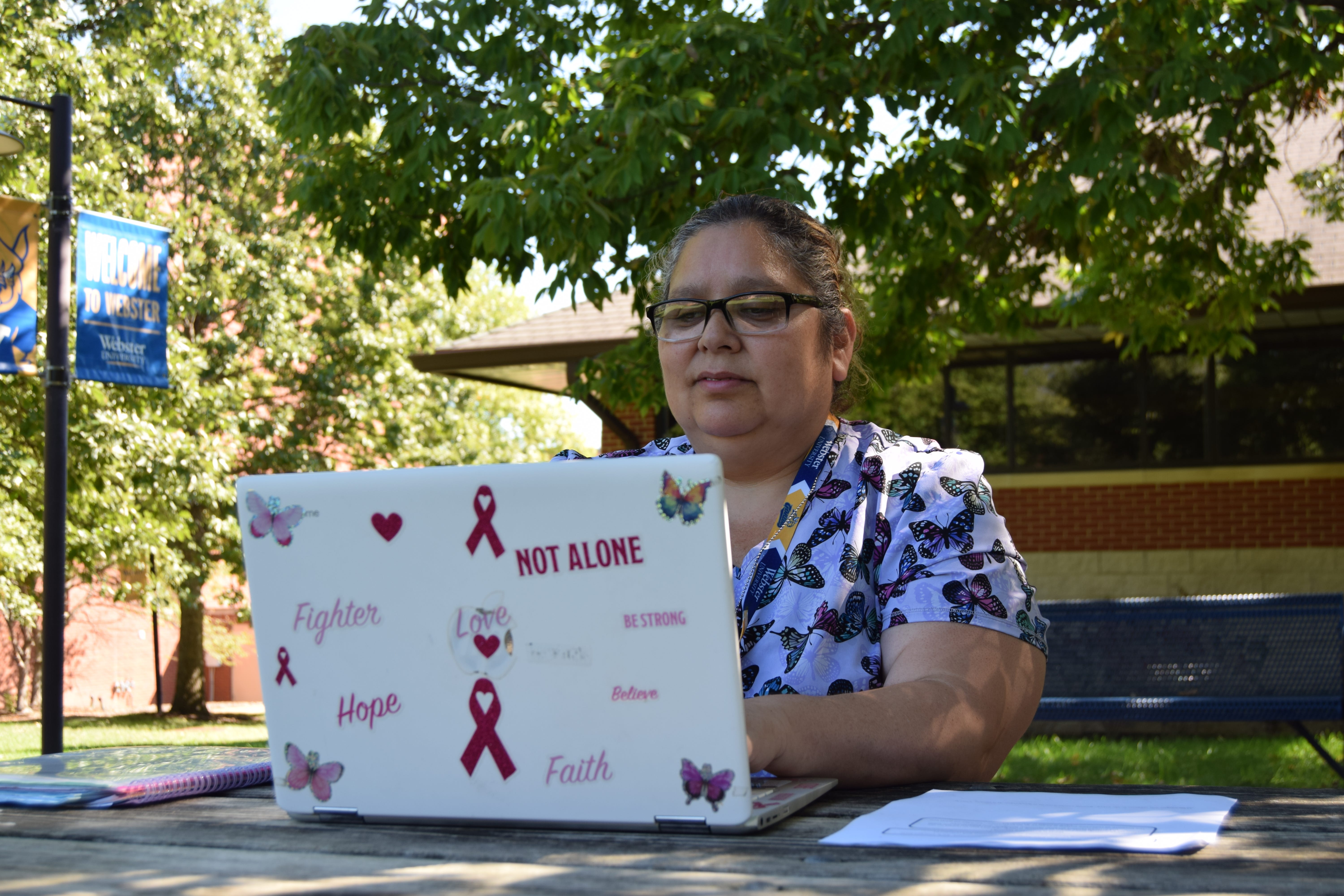
“One of my reasons to pursue a degree in legal studies is I want to help people with immigration issues,” Zamora said.
Zamora prides herself on her familiarity with the legal system, specifically in terms of immigration, having gone through it herself.
When she initially moved to the States, the government denied her family’s asylum and deported them back to Mexico. Her mother, still worried for their safety, tried yet again.
“I had to cross the Rio Grande River in an inflatable raft to the United States,” Zamora said. “We had to do it the illegal way, even though it was not right, but we asked for help and it was denied.”
According to the Department of Homeland Security (DHS), in 2023, around 79% of affirmative asylum applicants (those currently in positive legal proceedings for asylum) reported being inside the U.S. before applying for asylum. Among them, 25% entered without inspection, just like Zamora.
After being in the country for 25 years, Zamora was finally able to obtain a green card and, later, her U.S. citizenship.
“When I became a citizen, the judge saw me crying the whole ceremony. And he was like, ‘You don’t have to be a U.S. citizen.’ I said, ‘That’s the most precious gift I have received from above [God], besides my kids,’” Zamora said. “The only reason I cried is because it took so many years and it cost me humiliations and tears, starving, homelessness and all that. But finally, I made it.”
Her journey to citizenship was no small feat. Within two and a half decades, she experienced homelessness, poverty, discrimination and found herself trapped in an abusive marriage.
Zamora’s abuser would routinely demean her, primarily utilizing emotional, verbal and psychological abuse to maintain power and control, including threatening her and her children, body shaming and forcing her to do his wishes, regardless of how she felt.
Her American citizenship finally gave her legal rights to fight back.
“Once I became a U.S. citizen, I was able to fly and do things on my own,” Zamora said. “There’s no way back.”
The National Organization for Women reported that 50% of immigrant women experienced abuse in 2017 — a rate nearly three times higher than the national average. Many other organizations estimate elevated numbers of abuse within this demographic, but report that the exact number is difficult to quantify due to people’s fear of getting deported if they report abuse to authorities.
Now, within the second Trump administration, immigration rights are under further scrutiny.
Last month, DHS announced a “new milestone,” stating that 2 million “illegal immigrants” were deported in under 250 days.
“With this political system that the president has, it’s gotten more dangerous for Hispanics because, even if you say just one word in Spanish, people go off on you and [say] ‘Go back to your country, you should not be here. You’re illegal! I’m calling ICE,’” Zamora said. “My anxiety attacks and panic disorder have grown immensely.”
Despite having no criminal background, Zamora finds herself feeling consistently discriminated against.
When she was homeless, she struggled to find resources willing to work with her due to her Hispanic identity. It didn’t matter that she was an American citizen.
“I wanted to give up at the beginning, but then I was like, ‘No, I got two beautiful children … if I go down, they’re gonna go down with me.’ And I don’t want that to happen,” Zamora said. “So, I have to keep motivating myself. This is not the end. There is always a light at the end of the tunnel.”
That light shined brighter in April when Zamora found her own place to rent. The one-room space consists of a makeshift kitchen within a basement. For her, it signals safety and a new life.
A month later, Zamora drove by Webster University and decided to check it out. Though she graduated from Forest Park Community College in 2017, she decided to enroll at Webster to continue her education and stay busy after treating her breast cancer for the past year.
With her prior work as a volunteer translator for LAMP (Language. Access. Multicultural. People.), she saw firsthand how striking the impact she could make, including to those in need of assistance at ICE offices and with the immigration process.
“It’s good to be wanted by people. People think that you’re very helpful — ‘You’re an angel, you are a blessing from above’ and all that,” Zamora said. “Those comments made me [realize] I need to keep on because a lot of people need me. I cannot give up.”
As she nears the halfway point of her first semester at Webster, Zamora balances schoolwork and the end of her chemotherapy treatments.
Zamora considers school to be one of her only safe spaces, one where she can thrive.
“Here, I feel like a butterfly. I can fly and learn and be myself,” Zamora said.